Undressing fast fashion: Breaking down the future of the fashion industry
By Amyah Bishop, Sean Perry and Sydney Thomas-Arnold
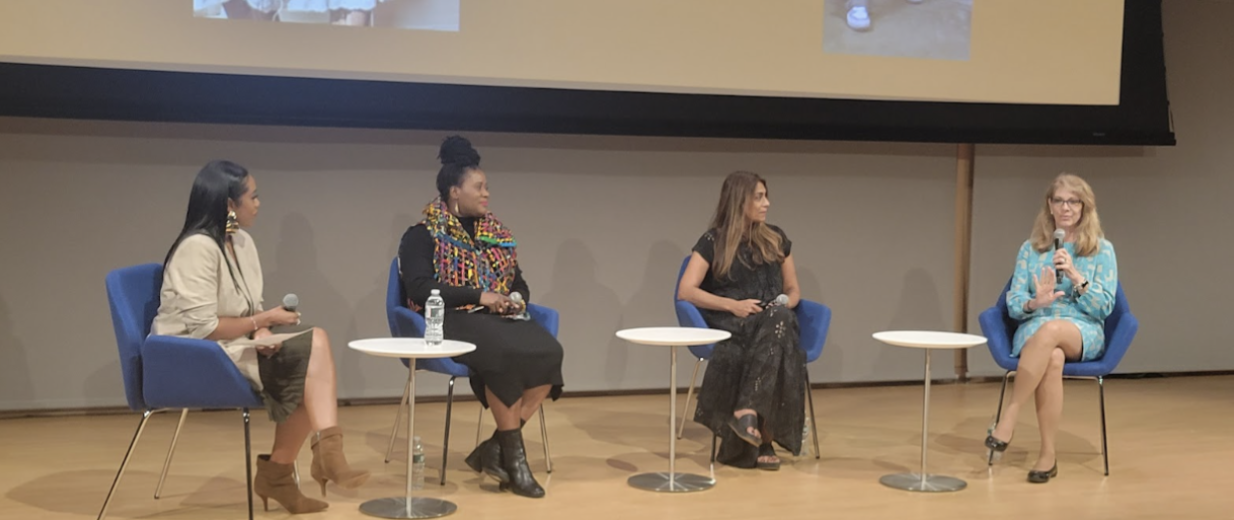
Pictured, left to right: Taneshia Camillo-Sheffey, Queen Allotey-Pappoe, Madhavi Venkatesan and Dr. Catherine Weiss. Photo by Amyah Bishop
Queen Allotey-Pappoe grew up in Ghana, where many people would spend their days fishing at the local lagoon – a lagoon that eventually dried and became a landfill. This area was a main source of food for many people, and without it they were forced to gather fish from other areas which were not as accessible. When she moved to the United States and immersed herself into the fashion industry, she learned the effects of fast fashion, realizing most of the items that were in the landfill were discarded clothing items from the West.
Pappoe runs her own sustainable clothing brand, Queen Adeline, where through environmentally friendly and sustainable practices she creates fashionable clothing inspired by African culture. She is pictured in the photo above, wearing a rainbow woven vest made of leftover pieces of cloth from her design studio.
“There are so many different other actionable things that can help bring sustainability back,” said Allotey-Pappoe. “Back to basic, and back to that communal level.”
On Oct. 5, in celebration of Boston’s Annual Fashion Week, an event called “Fabricating the Future of Fashion” was held at the Boston Public Library and consisted of a discussion Q&A panel with sustainability experts. In this discussion, hosted by Taneshia Camillo-Sheffey, founder of The Haute House and MadeIncubator, the panelists, one of which being Allotey-Pappoe, shared their takes on the fast fashion industry and the intersection of fashion and environmentalism.
“Sustainability is a value structure,” said Madhavi Venkatesan, a Northeastern University economics professor. “It’s how we see the world and how we want the world to be.”
They touched on the toxicity surrounding the culture of consumerism in the U.S., and how it is up to the consumer to combat environmental damage through conscientious shopping decisions. Dr. Catherine Weiss, professor at Lasell School of Fashion, also explained the triple bottom line theory, which aims to measure a company’s success not only through its individual economic profit, but through its contributions to society’s overall social, environmental and economic well-being. While sustainability should be created and practiced on a large scale through these business actions, it is up to the individual as well.
“A portion of it rests with us and how we consume with our money,” Venkatesan said. “The bottom line is each of us is a consumer, investor and member of government. We hold individual power, our greatest power is coming together to solve these issues.”
Allotey-Pappoe said it is possible to create quality products independent of the consumerist system. She explained that through the maintenance of a transparent supply chain, she knows exactly where her fabrics come from and how they are made. Without maintaining visibility in the fashion industry, consumers do not truly know how their products are being sourced.
“You have folks somewhere in a high-rise building coming (up) with designs, trend researchers coming up with things that need to happen far removed from manufacturing,” said Allotey-Pappoe.
Within modern discourse, there have been many concerns surrounding the issue of fast fashion and how it is up to today’s youth to counteract the negative effects of unsustainable consumerism. Despite the fact that the environmental damage in question was caused by the ignorance of past generations, this is still an issue that must be dealt with immediately.
“The underlying problem of our generation and society is we want one quick fix,” said Allotey-Pappoe. “Reframing our mindsets to that, versus what are the steps we can take, would be the beginning of truly moving this ball forward.”